The nice thing about Illustrator, and programs like it is that with one click you can have the program draw a box (or any shape you like) with dimensions you provide to it and it is easy to change the size of these objects. Although there are a wealth of tools in the program, for my purposes, I used only about 2-3 of them, making it very easy to use and understand.
 Here is the prototype I would use to get started. The first thing I needed to do was search the Internet and hobby shops for suitable windows and doors for my bank. Once I had those, then it would be easy to start the diagram as I would have some base sizes I needed to start with. My foray to the local hobby shop (LHS), did find a good selection of windows and doors, which I purchased with the intent of using on other buildings.
Two major companies exist to my knowledge that provide a decent selection of parts.
Tichy Train Group: http://www.tichytraingroup.com/
Grandt Line Products: http://www.grandtline.com/index.html
Both are model train companies and are probably the most used when it comes to scratch building parts like windows and doors, although they do offer many other things. Both also not only give a nice description of each item, but also a small picture and sizes, which was key. When using something like a window there will usually be two measurements, one for actual item size and one for the opening needed size.
For my purposes, I searched both sites' N scale selections and ended up deciding to use the Tichy masonry windows, 2523 – 40 pane engine house windows and 2502 – 6/6 double hung masonry windows. This decision was based on the fact that my bank needed large mutlipane windows that would span most of the available space above the doors as in the Broadway prototype. The 40 pane windows were the longest windows available and thus were the ones I needed. For the smaller windows at door height, my decision was based on the 40 pane windows. I needed something that would look cohesive together. Both these would need to be ordered directly from Tichy as my LHS did not have these in stock. At $3 US a pack, it would be a very good deal.
Fortunately, I had bought some doors on my previous excursion that would work.
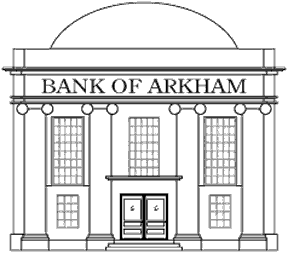 Here is my diagram of the front of the Bank of Arkham. I started as close to the prototype as possible, but soon realized that using six columns and five windows on the front made the building a bit bigger than I wanted. Remember that the front of the building would need to be at least 2.5 inches long to accommodate the loan cards standing on long side inside the building, so the front had to be at least that length, but at the same time, I needed to conserve as much space as possible. Reducing the number of windows and columns on the front allowed me to shorten it up to about 2.75 inches long.
After that it was simple to place images of the windows I would use at the correct size and start adding columns and doors. Most of the detail has been added to this diagram, which typically would be unnecessary at this stage, but I am a glutton when it comes to planning.
The columns are iconic so I will be adding the caps, identified as those round shapes at the tops, probably by printing them on nice paper and gluing them on. I added an extended door portico and some steps to give it some architectural detail.
The bank is a box and will open just above the title on the top where the extended overhang protrudes. Everything above that point will be a separate piece which will be hinged in the back. The powerful magnets will go, one over the other in each section, most likely in the middle of the front and be hidden inside each box area, one behind the title and one in the above area of the lid. I also added a rounded top to the lid and although none of my prototypes have this, I felt it added to the architectural shape of the building, would allow me to use less roof detail parts, which could be broken easily from handling, and would provide a bit more strength to the lid.
 Here is one side. Since both sides are identical, there would be no need to diagram both. The back of the building would have very little detail and would, in this model, mostly be a concrete wall. I will add a small back door off to one side but there will be no windows or columns on the back. The side area is 2.25” long. Not all the detail and parts are added to this diagram as it wasn't needed here and most of the calculations were preformed on the front. The front overhang would actually be supported by the front columns (not shown) and I did not add the rounded roof from this angle.
Again, the top protruding trim defines the lid opening and since the hinge would be in the back, I did not want the trim to extend out the back. Doing so, would have made it so the lid could only open to 90 degrees maximum. Designed without the trim allows the lid to open to 180 degrees, although I may add inside fabric bracing to stop it from opening more than 115 degrees or so.
Since we are talking about the lid and hinge, I should probably describe how that will be made. After much research, ideas, and discussion with some helpful people, I decided that the hinge would simply be a swatch of fabric glued to the inside of the back wall and to the under side of the lid. Fabric would allow it a bit of play to avoid breakage and the tensile strength would be better than anything else I could use. Adding any kind of hinge other than this on the back would run the risk of being weak at the glue points. A simple twist in the wrong direction when opening it would put pressure on these glue points and most likely result in breaking it off. With fabric I would have a larger glue area and a stronger hinge as the result.
 This is a diagram of the bank looking down from the top and shows some insides. This was actually one of the most difficult diagrams to do and it is shown here only in it's most basic form. The actual diagram has a few other layers which show the lid and the section just above where the columns stop. It all fairly intricate and confusing, so I did not include that, but basically I wanted to give the reader an idea of how the interior would look and be designed.
Section A is the vault, a small box 1.5” wide by 1” high by .75” deep to hold two D10 dice.
Section B is another slim box 2.5” wide (plus a bit) by 3/16” high by 1 5/8” deep (again, plus a bit) which will house the loan cards. It is a bit over sized so the cards will have a little bit of extra room and not be damaged or difficult to remove. Also the eight loans cards stack to about 1/8”, but I added a bit more room for future expansion cards if needed and may increase this to 1/4”.
Section C is the bank interior which will be lit from a hole in the bottom and LED lights strung up through to the inside.
Section D is also interior and will be lit from section C. The dividing wall (if I even use one that extends the full length) will have the sections from the outside wall to the section A wall cut out to allow light to reach section D.
The rest of the details here are things like the columns on each side, the portico over the doors, the stairs, and even some of the structural supports (the small squares and rectangles on the inside walls). Some of this, especially the structural portions might be changed during construction, but I needed to understand how much room I had and how I was going to place everything inside.
A final note on the columns. I will be purchasing half round tubes and rods for these online, as my LHS didnt have them. Two great sites that I know of exist for styrene and plastic building materials.
Evergreen Scale Models: http://www.evergreenscalemodels.com/
Plastruct: http://www.plastruct.com/
Now to wait for my orders and finally get building.


No comments:
Post a Comment